Showing posts with label Continuous. Show all posts

Monday, 12 July 2010

ISA 106 - a Simple Hierarchy diagram

Just an initial proposal!


Saturday, 10 July 2010

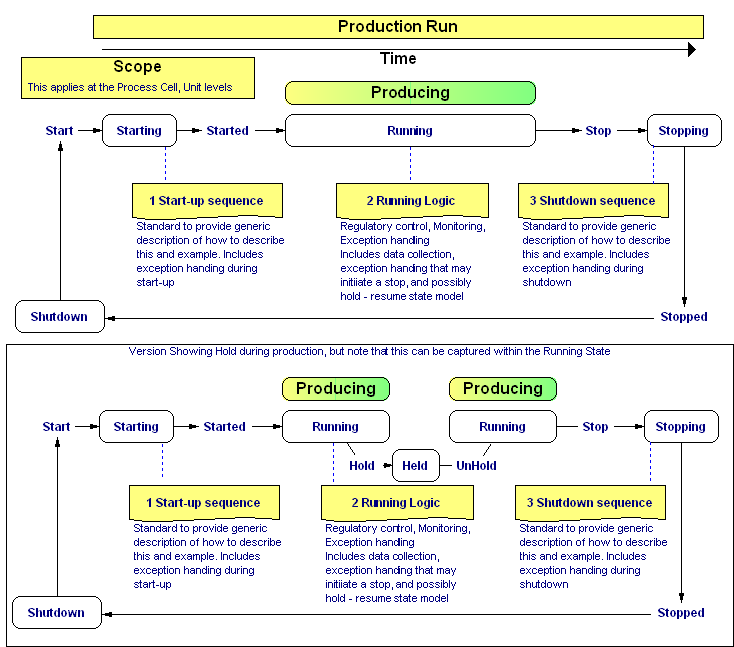
Suggestion for ISA 106 - The Production Run

This ISA 106 Production Run overview diagram shows a suggested high level state model for a Production Run
A Production Run is a suggested new Term that covers the operation of a Unit or Process Cell from shutdown through Starting, Producing to Stopping and back to ShutdownThe Production Run
Click the diagram to see it full size

Saturday, 5 June 2010

ISA106 - What is a continuous process anyway?

You can read about the new ISA106 committee here. It is intended to develop standards, recommended practices, and technical reports on the design and implementation of procedures for automating continuous process operations.
One question this raises is what a continuous process really is! So let's look at a couple of real processes.


The first example is from the biotech world, the second from petrochemicals

Fermentation - there are some very large processes with fermentation at their core. Some use entirely batch whereby the fermentation is done and then the fermentation product is transferred downstream as a single batch. But there are others that run the fermenter continuously for as long as they can (many weeks) whilst periodically taking fermentation product out. Is this batch or continuous? They most certainly have recipes. And either way they spend a lot of time in a single controlled state that is essentially governed by control loops. I know of many such processes and both types use S88 oriented implementations.

The Unipol process. (A nice animation, note the batches appearing in step 6)
Much like the continuous version of the fermentation process this runs with a continuous feed but product is taken from the reactor in batches. Different grades of product can be made by changing the set points (recipe formula!) without shutting down. Is this batch or continuous?   This process too spends much of it's time in a single controlled state that is essentially governed by control loops.

It is not really important. but ff the two, the fermentation processes I have seen are more complex, but in part this is due to CIP complexities. On the other hand the Unipol process has more complex control loops and higher level optimisation systems.

I suspect the petrochemical industry is right up 106's street and the biotech industry is not

So what will distinguish the sort of process (or is it industries?) that 106 is to be aimed at?
This is a key point that must be resolved at the meeting


Finally a note -  there used to be a link to the Official ISA Part 5 Blog 

But this is presently unavailable as controlengineering.com has closed. Supposedly it will return.

Wednesday, 5 May 2010

ISA106: Procedural Automation for Continuous Process Operations

A new standard is being proposed, called ISA106: Procedural Automation for Continuous Process Operations
The WBF website provides a description of the forthcoming effort.

In the very early days of S88 Part 1, in October 1995 I presented a paper at the EBF in Dublin titled “Extending SP88 into continuous and semi-continuous processes.”

One point I made was that the Recipe operations for a continuous process are distributed in Space rather than time. So the sequence of process operations to make stuff happens continuously in a stream of equipment.

The essence of this is exactly the same as defined in part 1 for batch, so a continuous operation still carries out a process operation - A major processing activity that usually results in a chemical or physical change in the material being processed .

And in a continuous plant the ‘sequence’ is achieved continuously as the material passes through the equipment, whereas a batch plant carries out the sequence of actions batch by batch and may carry out many of the sequence of operations in the same equipment.


Since then I have further developed my understanding this to encompass how to make continuous processes (or discrete ones) exactly the same as batch..

The essence here is that the procedures needed to make a quantity of stuff or things as from the operation viewpoint can be identical for both batch and continuous.

This is predicated on the idea that the procedural operation of plants, whether batch, continuous or discrete can be the same. And that these procedures do not need to work real time – or at least in the time domain needed to control equipment.

Unfortunately (from an s88 purist’s point of view like mine) the procedural aspects of part 1 have been taken by many to prescribe a means of controlling equipment.

Now the concept of combining sequential control with state orientated control is a very powerful one, capable of controlling highly complex processes. But in my view these equipment sequences are not the same as the procedural level that puts together product independent equipment control to make stuff.

And I have never agreed that the procedural level as described in the original Part 1 was intended for equipment control. It was intended to provide the means to map equipment control to the operational procedures needed to make stuff. And no more.

But practise has not been that, and what we now have is a lot of systems which use recipe managers to perform equipment control - and I am convinced that this has been detrimental to many projects.

Now, referring to the Dow/ABB State based Control architecture I know it very well and I have in fact worked with Dow and Yahya to develop ControlDraw to support it even better than it used to.

But I do not believe that it is really S88 based, apart from the division of units into equipment modules (which by the way are not recipe aware) and control modules. The entire procedural level in the examples of this approach is missing, yes there are sequences to start up and shut down the equipment, but they are not in my opinion even phases as they do not perform process actions. For example, a sequence to start a distillation column is not a phase because it does not perform a process action, it just sets the column into the state where it can perform the distil process.

There is much more to say, for example about equipment requirements and routing etc. But I do ask that the ISA106 group consider what I am saying about the procedural level being an operational level rather than a control level.

Monday, 18 January 2010

S88 for Continuous Processes

There is a new article on ControlGlobal

ISA-88 Works for Continuous Processes Too
Using ISA88 Principles to Address Procedural Operations in Industries Outside the Traditional Batch Realm

But it has no opportunity to make comments on it, so I will blog it.
S88 for continuous processes has been a topic for years.
This article says, "A procedural operation is a set of tasks conducted the same way time after time to achieve a certain goal"
Well, that is not actually the complete story - why? Because it misses out the batch.
And there is always a batch. Even in a continuous process.
I have commented on this before, look at the continuous tagged entries in this blog for more.

Friday, 27 November 2009

Where is the Batch?

Continuous and discrete processes can be used to make batches of stuff or things. That is the key to using S88 outside of batch processes! There is always a batch!

Is this the most misunderstood aspect of S88? It is not hard to understand at all:

A Continuous process can make a batch by running for a period of time with a set of recipe parameters such an Flow, Pressure, Temperature etc

A Discrete process can also make a batch - in this case a quantity of the items it makes - by running for a period of time.


Wednesday, 30 September 2009

S88 and Continuous plants

S88 Batch procedures carry out an ordered set of process operations on a finite quantity of stuff, batch by batch.

This ordered set is called by Part 1 a Recipe Procedure. It can be represented as a sequence of operations in time, typically by PFC/SFC logic .

A sequence of operations may take place in one place (or Unit) or different stages may take place in different units.

Note – this implies transfers, which S88 carefully does not attempt to explain.

Continuous production also carries out an ordered set of process operations, however the quantity of stuff is not finite, instead it grows in time, and more than that, most operations take place in Units that are specific for the operation, the chemistry happening as material flows through the unit.

Thus, the recipe procedure for a continuous process may well be represented as a process flow sheet - without the need for a PFC. And, actually the transfers are then implicitly described.

By the way, yes, PFC’s or SFC’s may be a good way to describe startup and shutdown and grade changes, that does not mean they are Recipe Procedures!

I have before suggested that Part 1 needs what I call a recipe equipment entity model, to underly the equipment requirements that are part of the (master) recipe.

I also suggest that the recipe equipment requirements are best described by a process flow sheet. This works with both batch and continuous.

The recipe view of the equipment should be generic, in terms of types of equipment, whereas the physical model must contain one or more of each of the types required by the recipe.

Where I seem to disagree with the work being done to “improve” Part 1 though (and this is compounded by the emerging Part 5) is that the procedural model is not a good model for actually controlling equipment. I think that State Based Control (check the tags on this blog) is a good example, it simply does not fit conventional S88.

There are ways in which Continuous process can be made to look like batch ones from the scheduling point of view, or even the broader point of view of an ERP or MES

In fact it is quite easy.

Tuesday, 24 March 2009

State Based Control

There is a new White Paper on ControlGlobal.com called "The Benefits of State Based Control" written by David A. Huffman from ABB
Walt Boyes calls it a "very important white paper". It is quite good and I recommend readers, specially those working in the Continuous process industries, to download it. You have to register with ControlGlobal to get it, but that is worth doing anyway.
The paper does not claim that SBC is new, and indeed it is not. In fact SBC - or something very similar, has been the basis for a lot of ControlDraw models since CD was first introduced, in the mid 90's, and that itself was based on previous paper based ways of specifying State Based Control.
And in turn these models were often then implemented using SBC, and on a variety of systems.
The paper also suggest that implementing SBC is something that ABB with it's 800ax system has removed barriers to. That may be so, but the paper is short on details. Interestingly one of the systems that CD models have been used to specify (and frequently) is Sattline, now owned by ABB themselves. A little known fact is that 800ax is a direct descendant of Sattline, a system that can probably claim to have been the first object oriented DCS, it has been around since the 90's.
One thing the paper mentions is ISA S88 Part 5, but I cannot really relate the paper to anything in Part 5.