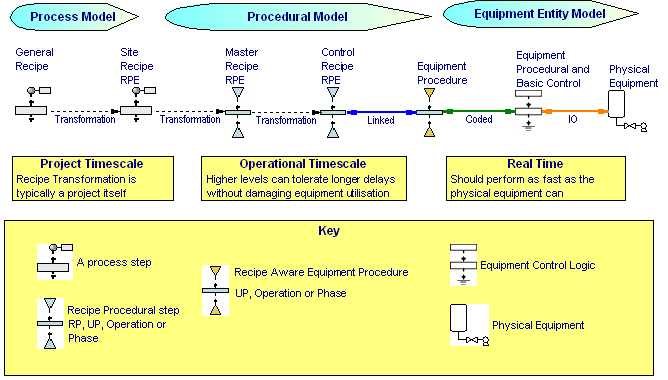
S88 Batch procedures carry out an ordered set of process operations on a finite quantity of stuff, batch by batch.
This ordered set is called by Part 1 a Recipe Procedure. It can be represented as a sequence of operations in time, typically by PFC/SFC logic .
A sequence of operations may take place in one place (or Unit) or different stages may take place in different units.
Note – this implies transfers, which S88 carefully does not attempt to explain.
Continuous production also carries out an ordered set of process operations, however the quantity of stuff is not finite, instead it grows in time, and more than that, most operations take place in Units that are specific for the operation, the chemistry happening as material flows through the unit.
Thus, the recipe procedure for a continuous process may well be represented as a process flow sheet - without the need for a PFC. And, actually the transfers are then implicitly described.
By the way, yes, PFC’s or SFC’s may be a good way to describe startup and shutdown and grade changes, that does not mean they are Recipe Procedures!
I have before suggested that Part 1 needs what I call a recipe equipment entity model, to underly the equipment requirements that are part of the (master) recipe.
I also suggest that the recipe equipment requirements are best described by a process flow sheet. This works with both batch and continuous.
The recipe view of the equipment should be generic, in terms of types of equipment, whereas the physical model must contain one or more of each of the types required by the recipe.
Where I seem to disagree with the work being done to “improve” Part 1 though (and this is compounded by the emerging Part 5) is that the procedural model is not a good model for actually controlling equipment. I think that State Based Control (check the tags on this blog) is a good example, it simply does not fit conventional S88.
There are ways in which Continuous process can be made to look like batch ones from the scheduling point of view, or even the broader point of view of an ERP or MES
In fact it is quite easy.